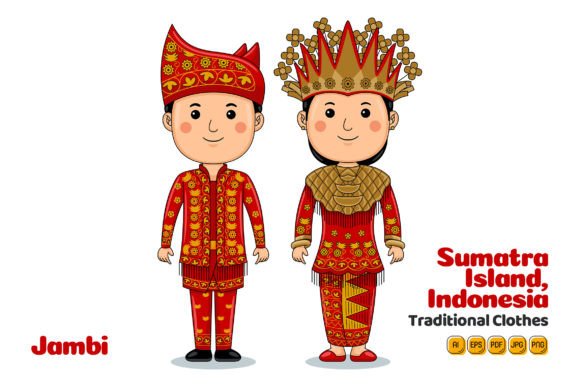
The Versatile Artistry of Jambi Traditional Cloth: A Design Asset for Modern Creativity
The rich cultural tapestry of Indonesia is woven with distinct regional identities, each expressed through unique textiles. Among these, the traditional cloth of Jambi stands out for its profound aesthetic heritage and symbolic depth. For generations, the artisans of Jambi have produced textiles that are not merely fabric but narratives, embedding motifs and patterns that speak of the region’s history, environment, and philosophy. Today, this artistic legacy transcends its cultural origins, offering a vast reservoir of visual elements ripe for contemporary application. When deconstructed into core design components, the patterns and forms of Jambi Indonesia Traditional Cloth become a powerful toolkit for branding, digital media, and illustration projects across numerous industries.
Deconstructing Jambi Textile Patterns for Digital Use
The first step in harnessing this traditional art for modern purposes is understanding its compositional anatomy. Jambi cloth, particularly styles like the Songket or woven fabrics with metallic threads, features repetitive geometric motifs, intricate borders, and harmonious color palettes. These are inherently systematic and balanced, making them ideal for vector illustration conversion. Each shape—a floral element derived from local flora, a triangular motif representing mountains, or a wave pattern symbolizing rivers—can be isolated as a clean, scalable vector object. This process transforms cultural art into a library of editable shapes, lines, and forms.
Core Characteristics of the Illustrative Elements
The resulting design assets possess several inherent advantages. They are typically flat design style in essence, focusing on clean outlines and solid fills without complex texture or shading, which aligns perfectly with current design trends emphasizing clarity and simplicity. The geometric foundation ensures that these elements maintain visual integrity at any scale, from a tiny social media icon to a large format banner spanning several meters. Furthermore, the traditional color schemes—often earthy tones complemented by gold or vibrant accents—provide a tested palette, but the vector format allows every hue to be modified instantly. This means a designer can adapt a Jambi-inspired motif to match any corporate branding guideline or campaign color scheme without losing the design’s structural elegance.
Practical Applications Across Media and Platforms
The utility of such a versatile illustration pack is vast, touching virtually every aspect of visual communication. Professionals in marketing and branding can leverage these elements to create distinctive identities, especially for businesses wanting to convey authenticity, craftsmanship, or a connection to natural themes.
Building a Unique Brand Identity
Consider a company specializing in organic products or sustainable tourism. Using abstracted patterns from Jambi cloth in their logo, packaging, or website background can subtly communicate values of heritage, balance, and natural harmony. Each vector element can be rearranged, layered, or combined to form a unique logo that feels both culturally respectful and entirely original. The ability to change colors of each and every shape ensures brand colors are perfectly integrated.
Enhancing Digital and Print Content
For content creators and educators, these illustrations serve as superior visual aids. An infographic about Indonesian culture or textile history can use precise representations of Jambi motifs to increase engagement and credibility. Social media posts gain a unique aesthetic, making them stand out in crowded feeds. For promotion materials, whether digital ads or printed brochures, borders, icons, and decorative elements drawn from this tradition add a layer of sophistication and artistic merit. Website designers can use these scalable vectors for section dividers, custom icons, or interactive hover effects, all while maintaining a lightweight, fast-loading format due to their vector nature.
Workflow Integration and Customization Freedom
A key consideration for professional users is how such assets integrate into existing workflows. A pack offering files in Ai, EPS, PDF, JPG, and PNG formats covers nearly all scenarios. The Adobe Illustrator (Ai) files allow deep, layer-by-layer editing for advanced users wishing to combine different elements and create your own illustrations. The EPS and PDF files ensure compatibility across other vector software and are ideal for print-ready layouts. The high-resolution JPG and PNG files, with transparent backgrounds, provide immediate use for web designers, video editors, or presentation software without requiring specialized graphic software. The specified size 4000 x 5500 pixel baseline guarantees that even the raster exports start from a massive canvas, ensuring quality in any derivative size.
Adapting to Diverse Project Requirements
The real-world relevance lies in the dynamic needs of projects. A landing page for a cultural exhibition might use the illustrations in full vibrancy, while a corporate annual report might use monochrome versions of the same shapes as subtle decorative elements. The same core pack can fuel countless variations because the elements are not monolithic images but building blocks. A designer can extract a single rhombus shape from a larger pattern, resize it independently, recolor it, and replicate it to form a new, modern background pattern that has a traceable lineage to Jambi textile art. This meets the principle of easy to edit customize, empowering rather than restricting the designer.
Considerations for Ethical and Effective Use
While the technical and aesthetic benefits are clear, responsible use of cultural motifs warrants consideration. Educators and researchers might prioritize accuracy in representation, using these illustrations to explain the original context of Jambi Indonesia Traditional Cloth. Business owners and creators should aim for informed adaptation—using the patterns in ways that honor their origin rather than dilute or misrepresent them. This approach aligns with E-E-A-T principles, demonstrating experience and authoritativeness by showing understanding of the source material. The illustrations become a bridge, not a appropriation, when their use is mindful.
Furthermore, the long-form informational value of such assets is significant. A comprehensive pack of 100 vector illustrations provides not just quantity but a deep dive into a single visual theme. This allows for consistent application across an entire campaign or brand ecosystem, creating a cohesive visual language. For hobbyists and amateur designers, it offers a guided entry into professional design, providing high-quality starting elements that reduce the intimidation of starting from a blank canvas.
Meeting Broad Audience Needs
The broad audience, from professionals to hobbyists, finds common value in the flexibility and quality. A professional graphic designer needs efficiency and compatibility; the vector formats deliver that. A small business owner needs distinctive, affordable branding assets; the ability to create countless variations fulfills that. An educator needs accurate, engaging visuals; the foundational authenticity of the motifs serves that purpose. This multifaceted utility underscores the real-world relevance of transforming traditional art into modular design systems.
In essence, the geometric poetry of Jambi’s traditional textiles, when archived and formatted as a modern illustration resource, ceases to be confined to fabric. It becomes a dynamic alphabet of visual form. Each project that employs these elements writes a new sentence in a contemporary design language, one that carries the rhythm and history of its origin while speaking clearly to present-day audiences. The scalability ensures longevity; the editability ensures relevance. This transformation from cultural artifact to creative toolkit exemplifies how heritage and innovation can coalesce, providing not just images, but a foundational methodology for distinctive visual creation across the spectrum of digital and print media.