The Power and Practicality of Football Icon Collections in Digital and Print Design
The visual language of sport is universal. A single, well-crafted icon can communicate a complex idea instantly, transcending language barriers and cultural differences. In the world of football, this visual shorthand is particularly potent. From the recognizable silhouette of a player in motion to the clean lines representing a goalpost or a trophy, these symbols form a foundational lexicon for creators across many disciplines. A comprehensive collection of football icons, designed with clarity and precision, becomes more than just a set of graphics; it transforms into a versatile toolkit for effective communication.
The Core Characteristics of Effective Football Icon Design
When discussing icons for football, or any sport, certain design principles are paramount. The primary objective is instant recognition. This necessitates a balance between simplicity and essential detail. An icon representing a “penalty kick” must be abstracted enough to be clean at small sizes but retain enough specific elements—like a ball and a spot—to be unambiguous. This is where vector-based design proves indispensable. Vector graphics are built from mathematical paths, not pixels, allowing them to scale to any dimension without loss of quality or sharpness. A football icon set built as 100% vector art ensures that the same symbol can be used on a mobile app button at 24 pixels and blown up for a stadium banner at 2 meters with identical crispness.
Another critical characteristic is stylistic consistency. A useful collection isn’t a random assortment of styles; it’s a cohesive family. Line weights, corner radii, perspective, and level of abstraction should be uniform across all icons. This consistency allows a designer to mix and match icons—a player, a whistle, a flag—within a single project without creating visual discord. It establishes a professional, systematic look, whether for an infographic explaining rules or a poster for a local tournament.
Editable Stroke and Customization: The Practical Advantage
The technical specification of an editable stroke is a feature of profound practical importance. Stroke weight, the thickness of the lines that form the icon, greatly affects its tone and usability. A thin stroke might convey elegance and modernity, suitable for a premium brand’s website. A thicker, bolder stroke feels more robust and energetic, perfect for youth league promotional materials. With icons built on editable paths in formats like AI or EPS, adjusting this stroke weight across the entire set is a matter of minutes in software like Adobe Illustrator or CorelDRAW, not a laborious redrawing of each asset.
Color customization follows the same logic. While a set might be provided in a monochrome default, the vector structure allows any element to be filled or outlined with any color. This enables effortless adaptation to existing brand color schemes. A club’s specific shades of red and blue can be applied, making the icons feel native to their communications. This level of customization extends to modification of the forms themselves; perhaps a designer needs to combine the icon of a ball with a specific number for a custom logo. The foundational vector paths make this advanced editing possible.
Diverse Applications Across Media and Industries
The utility of a clean football icon set spans an astonishing range of applications, far beyond the obvious. This breadth is a direct result of the quality and format of the assets.
Digital and Interactive Environments
In website and mobile app design, icons serve as intuitive navigation elements. A “league standings” page might use a trophy icon, while a “live match” section could be denoted by a whistle symbol. The PNG transparency files ensure these icons integrate seamlessly over various background colors and images. For social media, these graphics become the building blocks for engaging posts—quick explainers, event announcements, or celebratory imagery. Their simplicity ensures they remain clear and impactful even when viewed on small smartphone screens.
Print and Physical Media
The vector EPS and SVG files guarantee high-resolution output for physical materials. Flyers, banners, and posters for football events rely on bold, clear visuals to attract attention and convey information rapidly. An icon set provides ready-made, professional artwork for these projects. In educational contexts, such as coaching manuals, school textbooks, or research presentations, icons can diagram plays, illustrate statistical concepts, or break down complex rules into understandable visual steps. Their clean design avoids clutter, focusing the viewer on the instructional content.
Broad Professional and Commercial Use
Business owners in the sports sector—from online retailers to local facility managers—use these icons to enhance their branding, instructional materials, and marketing collateral. Hobbyists running community blogs or fan sites can elevate their content’s professionalism. Even professionals outside direct sports, like journalists or data analysts, find these symbols invaluable when creating content that touches on football themes. The easy drag-and-drop nature of the provided file formats, coupled with the ubiquitous support for PNG and SVG in standard software, lowers the technical barrier, allowing users of varying skill levels to implement them effectively.
Considerations for Selection and Implementation
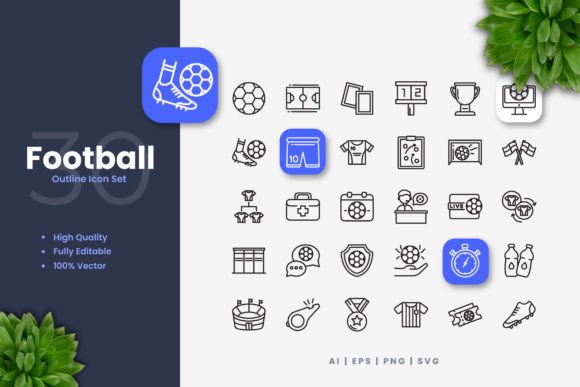
Choosing a football icon collection requires attention to both scope and technical delivery. A set with 100 vector icons should cover a wide spectrum of the sport: not just players and balls, but also equipment (nets, goals, boots), actions (passing, shooting, saving), concepts (tactical formations, awards, penalties), and associated symbols (timers, flags, medical crosses). This comprehensiveness ensures that most projects won’t require supplementing with incompatible graphics from another source.
The inclusion of multiple source file types is a key indicator of versatility. The AI file serves as the master editable source for professionals. The EPS Version 10 format ensures compatibility with a wide historical range of design and print software. The SVG file is the standard for modern web development and scalable interactivity. The PNG files with transparency offer immediate, hassle-free use in almost any environment. A simple Readme.txt file that clarifies the contents and formats adds a layer of user-friendliness, guiding non-experts toward the right file for their task.
It is important to note that preview mockups showing the icons in hypothetical scenes are often for demonstration only and are not included as part of the core usable assets. The real value lies in the raw, editable icon files themselves. Their true potential is realized when integrated into the user’s own unique projects—a website they are building, a poster they are designing, an app they are developing. The icons become a modular component of their creativity, not a pre-composed scene.
Workflow Integration and Long-Term Value
Integrating such a collection into a creative workflow streamlines production. Instead of searching for or creating individual graphics for each need, a designer has a consistent library at hand. This saves significant time and ensures visual cohesion across multiple projects or over extended campaigns. For organizations, this represents long-term value; the icons can be used season after season, in different contexts, always remaining fresh because they are so fundamentally adaptable. Their clarity and ease of customization mean they won’t become visually dated as quickly as more stylized, complex illustrations might.
Ultimately, a well-designed football icon set addresses a fundamental need for clear, scalable, and adaptable visual communication around the world’s most popular sport. It empowers a broad audience—from professional designers to educators to small business owners—to convey ideas about football with efficiency, style, and impact, across any medium they choose.