SEO SEM: Distinguishing Digital Marketing's Two Essential Approaches
For professionals navigating the digital landscape, understanding the distinct roles of SEO and SEM is foundational. SEO SEM, often discussed as a pair, refers to Search Engine Optimization and Search Engine Marketing, two methodologies with intertwined goals but different operational principles. SEO focuses on organic, unpaid efforts to improve a website's visibility in search engine results pages. SEM encompasses SEO while also including paid strategies, primarily pay-per-click advertising. Recognizing what makes each distinct is crucial for allocating resources effectively.
The core distinction lies in cost, control, and timeline. SEO is a long-term strategy built on content quality, technical website health, and authoritative backlinks. Its results accumulate over months, building sustainable organic traffic. SEM, in its paid advertising component, offers immediate visibility through purchased ad placements. This immediacy comes with a direct cost and the limitation that traffic ceases when spending stops. A holistic SEO SEM strategy, therefore, seeks balance: building lasting organic authority while using paid search to target specific gaps or accelerate short-term campaigns.
Key Components and Their Practical Implementation
Effective SEO SEM relies on several pillars. For SEO, these include on-page elements like meta tags, structured content, and internal linking. Off-page SEO involves earning references from other reputable sites. Technical SEO ensures a site is fast, secure, and accessible to search engine crawlers. The SEM paid component, often managed via platforms like Google Ads, revolves around keyword selection, ad copy creation, audience targeting, and ongoing bid management.
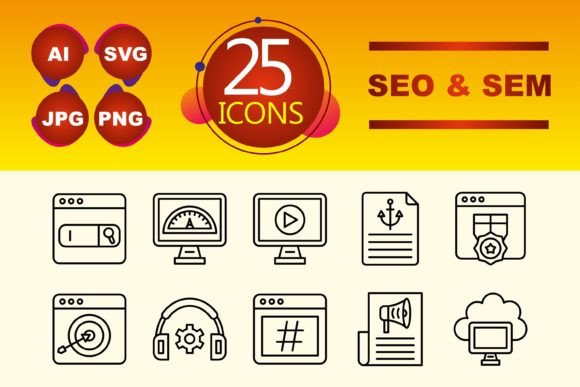
Visual communication plays a subtle yet important role in explaining these concepts, both internally to teams and externally to clients. Sets of SEO SEM icons, designed in a clean Line Icon style, can serve as valuable assets. Such icons can visually represent concepts like "keyword research," "ranking," "ad spend," or "analytics" in mobile app interfaces, website administration panels, presentation slides, or infographics. Their utility lies in creating a consistent visual language across educational and operational materials.
Evaluating Different Approaches and Resource Formats
When building a SEO SEM knowledge base or toolset, professionals often compare various resource formats. Written guides, video tutorials, software platforms, and visual aids like icon sets each serve different needs. A well-designed set of SEO SEM icons, offering files in AI, JPG, PNG, and SVG formats, provides versatility. SVG files are scalable without quality loss, ideal for web and app development. PNG and JPG are standard for digital presentations and documents, while AI files offer editable vectors for designers who need customization.
The choice between such resources depends on the primary use case. For a developer building a dashboard, SVG icons might be the priority. For a marketing consultant preparing client reports, ready-to-use PNGs could be more practical. A complete set covering multiple file types removes friction, allowing the same visual concepts to be deployed across an entire workflow from design to final output.
Strengths and Trade-offs of a Unified SEO SEM Strategy
Adopting a combined SEO SEM approach offers significant strengths. It allows for comprehensive market coverage: SEO captures users researching broadly, while paid SEM can target specific commercial intent. This combination also provides data synergy; insights from paid campaign performance (like high-converting keywords) can inform organic SEO content strategy. However, trade-offs exist, primarily in resource allocation. Budget and personnel must be split between two disciplines with different skill sets and measurement cycles.
Another consideration is the evolving search landscape. Features like Google's local packs or shopping results often blend organic and paid listings, requiring an understanding of both to compete effectively. A purely organic-only strategy might miss urgent opportunities, while a solely paid approach risks building no lasting digital asset. The best-fit situation for a unified SEO SEM strategy is typically an established business with a sustainable budget that views digital presence as a long-term investment.
When SEO SEM Visual Assets Become a Practical Choice
Specialized icon sets find their niche in specific scenarios. For teams creating internal training materials on SEO SEM, clear visuals can accelerate comprehension. UI/UX designers prototyping analytics software for marketing clients need symbols that instantly communicate domain-specific functions. In these cases, a dedicated set of ten line-style icons covering core SEO SEM concepts can streamline design and communication.
Limitations of such resources are also worth noting. Icons are aids, not substitutes for deep knowledge. Their usefulness is contingent on their design clarity and coverage of the needed terminology. If a set lacks an icon for a critical concept like "click-through rate," its utility diminishes. Therefore, evaluating the scope and artistic clarity of the icons is as important as checking the provided file formats.
Making an Informed Decision on Strategy and Tools
Deciding on your emphasis within SEO SEM involves assessing your business context. Start-ups with immediate product launches might lean heavier into paid SEM for quick traction, while content publishers or service firms with longer sales cycles should prioritize SEO. The decision factors include budget timeline, in-house expertise, and competitive intensity in your search landscape.
Similarly, selecting ancillary resources like icon sets or templates requires aligning them with your primary outputs. If your team frequently creates client presentations, a library of SEO SEM visuals in easy-to-use formats is a logical investment. If your work is more backend-focused on analytics or coding, such assets may be less central. The key is to match tools to your dominant workflows.
Ultimately, a nuanced understanding of SEO SEM—both as a marketing framework and as a subject requiring clear communication—enables more strategic decisions. By recognizing the distinct attributes, strengths, and trade-offs of each component, professionals can craft balanced digital strategies. And by choosing appropriate supporting resources, from software to visual aids, they can execute and explain those strategies more effectively, whether targeting organic growth, paid visibility, or the integrated power of both.